
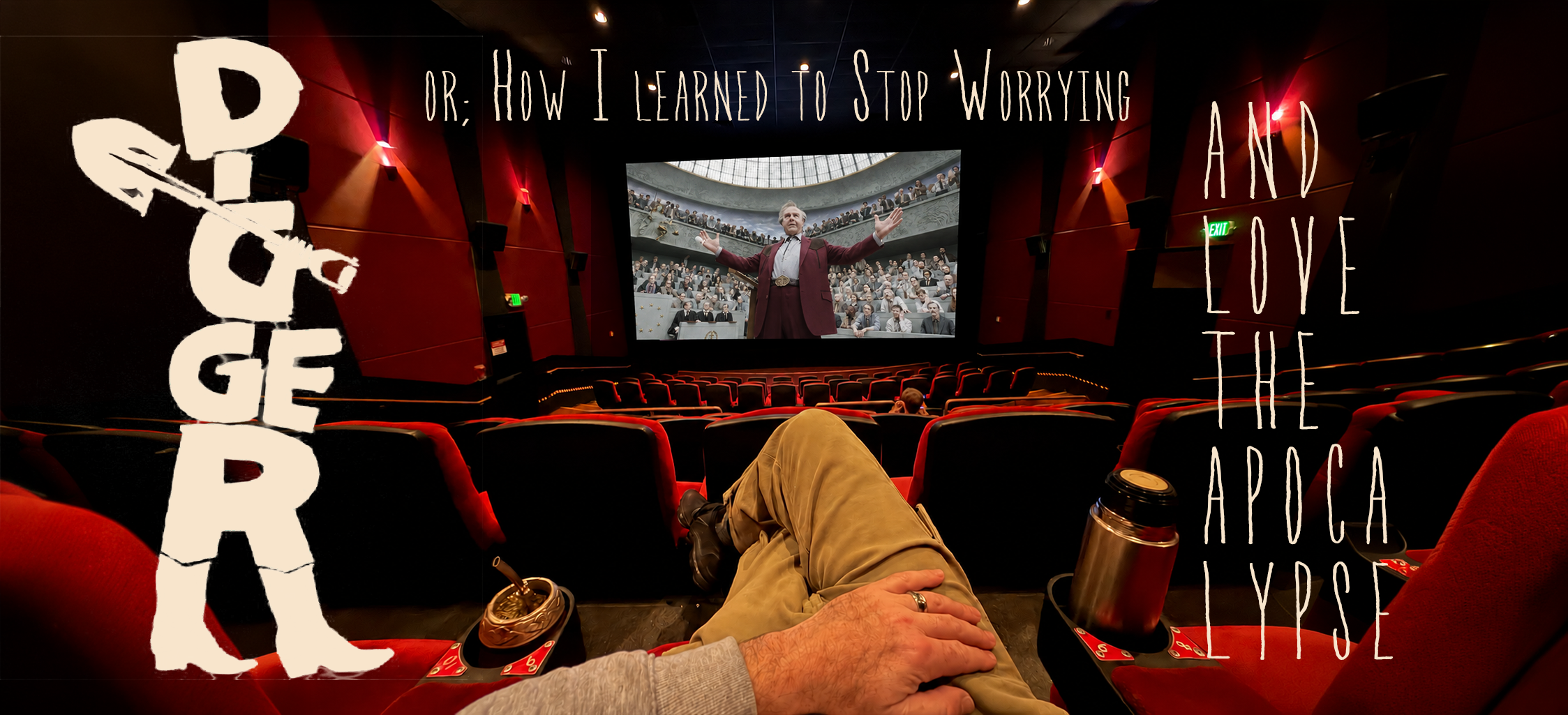
When the lights came on, there were six of us seated. As I waited to validate my parking ticket I overheard a woman, one of the five people in line, emphatically arguing that there had to be “a malignant hit-job campaign on this movie! How could a film so good be so poorly received?”
Recently, acclaimed documentaries like Naza and Musk have had to either resort to self-distribution or accept a short theatrical footprint due to intense political controversy and alleged death threats. But Digger is not a documentary, and I wouldn’t say it represents an obvious menace to the forces it portrays. At least not directly. For nuance, this is another auteur picture by director Alejandro González Iñárritu, made with a robust budget and produced by Warner Bros. So we're not talking about an indie with limited screenings at the Angelika. I saw Digger at Century City’s AMC, one of the most mainstream venues in West Los Angeles. Street Fighter was playing down the hall.
As I left the vanishing universe on screen, I texted a friend in Argentina, who had insisted I watch the film before it was taken down: “Tom Cruise is not human. He’s like Messi,” I wrote. I meant it in the sense that both seem to challenge our assumptions about what is humanly possible, each in his own field. I thought of Argentine writer Alejandro Dolina, who distinguished Messi’s genius from that of a previous-generation child prodigy, Diego Maradona: “We need only a single play to realize Maradona was the best of his time. With Messi, we must acknowledge his whole career.” And to me, that requires not only looking backward, but forward, too.
Over the past weeks, my social feed had been prompting petitions and public appeals by prominent figures, from Guillermo del Toro to Neil Young and Ben Affleck, imploring audiences to support this movie. Their pleas praised its remarkable filmmaking, of course, but also acted as a collective outcry against the extinction of films of this nature, both already produced and yet to be conceived. By ‘this nature,’ I mean the films that scholars, critics, and film students eagerly anticipate. My own viewing experience of Digger was thoroughly enjoyable, although spiked with fleeting moments of disconnect that I will try to make sense of here. So I chose to refrain from blaming the film’s tepid reception on some form of higher-up puppet-mastering and instead ask: what may have happened with Digger?
Have modern-day critics become overpowered by undemanding, mind-numbing, high-octane franchise-based entertainment?
How patronizing of me. To clarify, critics can be insensitive executioners who need only twenty minutes to destroy the labor of love of a filmmaker’s last decade. But having an “elevated sensitivity” is not a primordial requirement for experiencing a film like this. At its most immediate level, Digger is an overt and rather explicit representation of how the interplay of power, self-confirmation, adoration, and outright denialism among those in authority can lead us all into catastrophe.
Through its hypnotic reimagining of chaos and dioramic backdrops, this production displays a figurative and literal stage for a climate apocalypse, which unfolds less through metaphor than through a mirrored reflection of the events we’ve all witnessed firsthand: successive government administrations obscuring the actual health status of their commanders in chief; presidents firing dissident voices that would otherwise bring educated analysis; religious dignitaries fervently anointing the president at the Oval Office on live television. We see it all. Every day.
Could audiences be coming down with a case of doomsday fatigue?
Lately, there’s been a plethora of dystopian pieces forecasting the apocalypse; yet most of these are soon rendered obsolete, as what they intend to warn or ridicule through fiction has usually been surpassed by a more frightening reality. Nothing in Digger is obsolete. If anything, one could accuse it of being ‘over-contemporary.’
Upon viewing, I was inevitably reminded of fundamental thematic and aesthetic period references like Stanley Kubrick’s Dr. Strangelove or: How I Learned to Stop Worrying and Love the Bomb and Orson Welles’s The Trial. Based on Kafka’s novel, Welles’s film is an abstraction: an expressionistic metaphor for the weight and absurdity of modern bureaucracy.
Digger’s departure, however, from films like Dr. Strangelove (which drew on genuine Cold War societal anxieties but was largely conjured by Kubrick as a way to banish and process his own paranoia) lies in the fact that the latter could lean on satirical comedy and exaggeration to process a world whose madness remained largely unimaginable, or at least, unknown. The War Room itself was entirely fictional, an imaginative construct of production design, as Ronald Reagan discovered when he asked to see it at the Pentagon.
But today, in “the era of information,” as tech CEOs proudly call it, one doesn't need much imagination to envision the carnival inside the corridors of power. These worlds, together with our own lives, have been fully exposed for everyone to see.
Are we struggling with the film's tonal ambiguity or its resistance to genre conventions?
In contrast to other films that frame ‘a life within a life,’ such as Synecdoche, New York (by Charlie Kaufman), Digger’s plot is less intellectual than sensorial. Interwoven, but not complicated. Its structure is built on a dialectical scaffolding, expressed through a dualistic tone that shifts back and forth seamlessly between opposing registers.
As throughout Alejandro González Iñárritu’s body of work, the orchestration of elements is indebted to a governing principle. In Birdman, which won the Academy Award for Best Picture, that principle was the surgical precision of an interrupted narrative, weaving together the mental fragility of a faded actor wrestling between sanity and ambition in the behind-the-scenes world of theater, all achieved in a single shot. In Digger, in a kindred spirit, the governing principle revolves almost exclusively around the multilayered crescendo of its two main characters: Digger Rockwell, the oil tycoon, and Curtis, the actor embodying him, both played brilliantly by Tom Cruise.
A dualistic camera approach, alternating between the prudence of studio-mode cinematography and documentary-style colloquialism, is always in service of Cruise’s measured energy and layers of truth. He is selective when intimate and transformative when grandiose.
Performances by secondary actors may feel a bit off kilter when they first appear on screen, especially when acting opposite Tom Cruise, and this might read as tone-confusion. But as the film evolves, grandiose set pieces and grotesque deliveries are themselves questioned by more vulnerable versions of the characters, who feel the need to inquire about the very pompous acting registers in which they are being asked to perform. These interrogations from within, asking how far the excess could hold up, are, in my opinion, what carry the film’s beauty.
In a scene reminiscent of The Trial, where Mr. K. struggles to preserve his sanity while defending himself against an accusation he has yet to understand, Tom Cruise reaches the pinnacle of his mastery during Rockwell’s public address at the European Parliament. He confronts an angry yet innocuous crowd, dressed in timid beige uniforms that seem to suggest no real opposition can emerge from their collective indignation.
I was reminded of the Book of Revelation 3:15-17 (which in Spanish is known as El Apocalipsis):
I know your works: you are neither cold nor hot. …So, because you are lukewarm, and neither hot nor cold, I will spit you out of my mouth. For you say, “I am rich, I have prospered, and I need nothing,” not realizing that you are wretched, pitiable, poor, blind, and naked.
Unlike in Kafka, everyone here seems to be aware of the crime in question: Rockwell, the parliamentarians, and both the on-screen and off-screen audiences. We all know what we're accused of. And we all know we're guilty.
But how far can satire go in confronting an already absurd reality?
In making my own films, I've learned that two scenes with equal emotional charge, when placed contiguously, tend to cancel each other out. The same may be true when an already absurd reality is dramatized in a similar key.
Legendary writer-director Paul Schrader has said to create his fictional universes by way of metaphors: the cab in Taxi Driver serves as a metaphor for loneliness; Jesus's struggle with answering his spiritual calling in The Last Temptation of the Christ is represented by recurring migraines and crippling seizures. For this technique to work, Schrader explains, there must be a healthy distance between the protagonist’s problem and the metaphor chosen as a bridge to the audience. If the metaphor is too far-fetched, audiences will have a hard time making the connection. If, on the contrary, it falls too close to the literal conflict, the resulting collision might seem redundant.
And here may lie a clue.
When analyzing trends in storytelling, scholar Howard Suber speaks of the "habituation" phenomenon that has cycled repeatedly throughout cinema history. Much like what happens with consumable substances, film audiences become desensitized to a given set of norms, creating the need for increasingly greater doses of stimuli to achieve equal satisfaction. In movies, this is generally attained through exacerbation: editing is faster, films get bigger, louder, bloodier. Eventually, a different avenue is chosen, usually in the opposite direction. But the films that are brave enough to pursue radically new storytelling approaches tend to be the martyrs who immolate themselves at the box-office front lines, while paving the way to entirely new possibilities. Dare I say, Citizen Kane?
Citizen Kane is an unquestionable precursor to numerous technical innovations, from its use of depth of field to its journalistic storytelling structure. Less often mentioned, however, is that it flopped at the box office upon its release in 1941. A few years later, renowned Argentine author Jorge Luis Borges wrote a review in which he called it “a labyrinth without a center,” a description that longtime friend Peter Bogdanovich confessed had haunted Orson until the end.
As we know, Citizen Kane drew heavily from the life of media mogul William Randolph Hearst, who also had a political career. In the movie, Kane’s character runs for office and loses. His reaction? Claiming fraud. This was said to be inspired by Hearst’s real-life grievances, who himself had run for mayor and for governor of New York, and lost all races. At the time, the parallelism between fiction and reality was too close for Hearst’s taste, so close that he boycotted the film and leaned on his influence in Hollywood to add hostility towards the movie’s distribution efforts.
Could the Hearst scandal have felt more at home on television for audiences at the time, as a running news story, than on the big screen as a cinematic embellishment of events? Film audiences will have more tolerance for “based on a true story” narratives than those “ripped from the headlines.”
Borges’ reservations towards Citizen Kane went even further:
I dare suspect, nevertheless, that Citizen Kane will endure in the way certain films by Griffith or Pudovkin 'endure': their historical value is denied by no one, yet no one can bring themselves to watch them again.
And I dare disagree wholeheartedly. When rewatching Citizen Kane a few years ago, this time with my daughter, she knew nothing about William Randolph Hearst or his political ambitions. But election denialism was a familiar notion in the aftermath of the 2020 elections. I asked her, “What does this remind you of?” She grinned smugly. A film that had failed financially upon its release was inadvertently helping a teenager make better sense of the political implications, almost 90 years later.
Wait. What if I am asking the wrong questions?
The question with Digger then might not be whether audiences suffer from doomsday fatigue, the film resists the comforting boundaries of genre, or that critics have become (more) insensitive. Yes, the distance between fiction and reality has collapsed, leaving us habituated to outlandish political events that seem confusing when dramatized through cinematic exaggeration. But confusing does not equal untrue.
And this is precisely where the film’s grotesquerie is not a tonal misfire, but rather a self-sacrificial byproduct. Unlike Dr. Strangelove, which used satire to digest the unimaginable, Digger projects a fictional future in which the actors themselves cannot fathom the madness of the past they are being asked to reenact. To be truthful, the tone must be ridiculous, which in itself risks failing to resonate with present day audiences because of its resemblance to reality, ultimately resulting in commercial disappointment.
Beyond all analysis, my visceral satisfaction with the film, my gratitude for it, lies not in its satirical, end-of-the-world theatrics, but rather in its compassionate duality: its life within a life. Rockwell’s stubbornness in itself finds its counterpart in Tom Cruise’s career-spanning commitment. Iñárritu’s ambitious feat echoes the selfless effort of the actors within the play, who show profound empathy for one another to bring to life a story whose full implications they may not grasp — at the time — but which they know is worth telling the world. Even if it’s too late.
What I appreciate about Borges's review, if anything, is that it opens up the possibility that a film's relationship with its audience, particularly in the realm of art, is never entirely settled at the moment of its initial encounter.
This is what time does to cinema. And Digger is owed just that: the benefit of time. Who is to say that ninety years from now, some teenager won't come across Digger and, like my daughter, find more than “historical value”: a lens through which to better understand their own present. And hopefully, within its fictional universe, a path forward.
If, of course, there is still a world to make sense of.



Quisque iaculis facilisis lacinia. Mauris euismod pellentesque tellus sit amet mollis.